Creatine after 50 can be a useful addition to resistance training, particularly for improving strength. Its benefits are generally modest, and it works best as part of a routine that already includes regular lifting, adequate protein, and recovery. It does not replace exercise or guarantee new muscle.
The most practical question is not whether creatine is popular. It is whether the supplement adds enough value to a sustainable training plan, given the person’s goals, health, medications, and tolerance. Understanding what the research actually measures helps set reasonable expectations.
A useful order of priorities: Establish regular strength training, build meals that provide adequate protein, and then consider creatine monohydrate if appropriate. Track strength and function rather than judging success from body weight alone.
What does creatine do?
Creatine is a compound made by the body and obtained from foods such as meat and fish. Much of it is stored in skeletal muscle, where it helps replenish the quick energy used during brief, demanding efforts. Repeated sets of resistance exercise are one setting in which that energy system matters.
Supplementing can increase muscle creatine stores. That may help a person maintain performance across repeated hard efforts, potentially supporting a little more productive training over time. It is not a steroid and does not act like caffeine. Feeling no immediate stimulation does not mean the supplement has failed.
The effect also depends on the training being performed. A supplement that supports repeated high-effort work is not a shortcut around learning technique or following a progressive program. The practical benefit should be assessed over weeks and months, alongside the work done in the gym.
What does research show in older adults?
A 2026 systematic review of creatine with resistance training in adults 60 and older included 11 randomized trials. It found a small additional benefit for muscle strength compared with resistance training alone or with placebo. The certainty of evidence for strength was moderate.
The pooled additional effects on muscle mass and physical function were not statistically significant, with lower certainty. That distinction matters: becoming somewhat stronger on a test does not automatically establish fewer falls, less disability, or a particular increase in independence. Those outcomes need their own evidence.
An earlier 2017 meta-analysis included 22 studies and 721 participants, with average study ages ranging from 57 to 70. Creatine groups gained about 1.37 kilograms more lean tissue during resistance training on average. Lean tissue, however, includes water; this was not proof of that amount of newly formed muscle fibers.
The reviews address related questions using different inclusion criteria and outcomes. Their results should not be reduced to a promise that everyone gains a fixed number of pounds of muscle. Individual response varies, and findings in generally healthy older participants should not be assumed to apply unchanged to frail people or those with major functional limitations.

Why lifting remains the foundation
Muscle needs a reason to adapt. A resistance program supplies that stimulus through repeated, progressively challenging movement. Creatine may support the process, but it cannot decide which muscles are trained, correct poor exercise technique, or compensate for sessions that never happen.
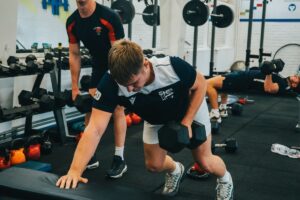
Two nonconsecutive strength days each week can provide a practical beginning. Sessions can cover the major movement patterns with exercises such as a chair squat or leg press, a row, an appropriate press, and a bridge or hinge. Machines, bands, and dumbbells can all fit a well-designed plan.
The initial challenge should be manageable. Someone who cannot perform a floor push-up might begin with a wall push-up. Someone unfamiliar with a leg press should learn the machine setup before adding substantial resistance. Good starting choices make the next workout more likely to happen.
Progress might involve another controlled repetition, a small increase in resistance, or improved movement quality. A brief training log makes these changes visible. Walking, balance practice, and mobility also deserve a place in the week because strength is only one component of physical capacity.
How much protein is enough after 50?
Protein provides the building materials needed to maintain and repair tissue. Adequate intake supports a resistance program, particularly when appetite is low or weight loss reduces total food intake. More is not automatically better, and a very high target should not crowd out the rest of the diet.
A meta-analysis of protein supplementation and resistance training combined 49 studies involving 1,863 healthy adults. Additional protein supported training gains, but the average extra benefit for fat-free mass leveled off near 1.6 grams per kilogram of body weight daily. The uncertainty around that estimate extended to roughly 2.2 grams per kilogram.
Those figures are approximately 0.7 and 1 gram per pound, respectively. They are not proof that every adult over 50 needs at least 1 gram per pound. The studies were not restricted to that age group, and the estimated plateau describes a population average, not a precise personal threshold.
For illustration, a 170-pound person weighs about 77 kilograms. An intake of 1.6 grams per kilogram would be approximately 123 grams daily, while 1 gram per pound would be 170 grams. Those are meaningfully different plans. A dietitian can help choose an appropriate target rather than treating the larger number as a universal minimum.
Body-weight calculations require extra judgment in people with substantial excess weight, low body weight, or medical conditions. A “desired weight” calculation can be a planning tool, but it is not identical to the actual-weight approach used in much of the research. Kidney disease or a prescribed protein restriction requires individualized advice.
Make protein practical at meals
Distributing protein across meals is often easier than trying to obtain most of it at dinner. A breakfast based only on toast and coffee leaves more work for later. Adding Greek yogurt, eggs, tofu, or another preferred protein food can help close that gap.
Lunch and dinner can include fish, poultry, beans, lentils, dairy, soy foods, or lean meat according to preference. A protein shake is a convenience rather than a requirement. Vegetables, fruit, whole grains, dietary fats, and sufficient energy still belong in the plan.
Labels list grams of protein per serving, which differs from the weight of the food itself. A few days of ordinary food records can reveal whether intake is close to the chosen target. The goal is a workable pattern, not perfect accounting at every meal.

Which creatine form and daily amount are commonly used?
Plain creatine monohydrate has the largest research base. A commonly used maintenance amount for healthy adults is 3 to 5 grams daily. This describes general research and consumer practice; it is not a personalized prescription for someone with medical limitations.
A loading phase uses larger amounts for a short period to increase stores more quickly, but it is optional. A smaller consistent daily intake builds stores more gradually over several weeks. Taking more is not a reliable way to obtain better long-term results.
Consistency is generally more useful than elaborate timing. Taking creatine with a regular meal can make it easier to remember, including on days without lifting. A missed dose does not require doubling the next one or restarting the entire routine.
Product labels deserve attention. The amount should refer to creatine itself, rather than a proprietary blend that hides the individual quantities. Independent quality testing can provide added assurance about contents and contamination, but it does not establish that a supplement is necessary or effective for a particular person.
Does creatine damage the kidneys?
A 2026 review of randomized studies on creatine and kidney function included 19 randomized trials and one randomized crossover study. Creatinine increased modestly, while pooled estimated filtration and urea measurements did not show statistically significant differences between groups. The authors called for more trials extending beyond one year.
Creatine can affect creatinine, a blood marker used in kidney assessment. A higher result does not automatically mean kidney damage, but an abnormal test should never be dismissed without evaluation. The clinician needs to know the supplement, amount, and timing to interpret results appropriately.
These findings do not establish safety for every dose or medical condition. Existing kidney disease, abnormal kidney tests, or a prescribed dietary restriction calls for individual medical guidance before use. Other markers or repeat assessment may be appropriate depending on the clinical situation.
What side effects and scale changes should be expected?
Water retention can increase body weight after creatine is started. That is not the same as fat gain, and it is not proof of rapid muscle growth. Waist measurements, training performance, and the overall trend provide more context than one reading on the scale.
Some people experience stomach discomfort. Persistent symptoms are a reason to reconsider the product and discuss whether adjusting or stopping it makes sense. There is no need to tolerate ongoing digestive problems to demonstrate commitment to training.
Keeping the rest of the routine relatively stable helps make changes easier to interpret. Starting creatine, a new diet, several other supplements, and a much harder workout plan simultaneously makes it difficult to identify what caused either improvement or discomfort.
A sensible way to evaluate the next few months
- Establish a baseline: Record current exercises, comfortable loads, and a functional goal such as easier stair climbing or carrying groceries.
- Build the routine: Schedule manageable lifting sessions and create meals that reliably supply the chosen protein intake.
- Review suitability: Consider medical history, kidney concerns, medications, product quality, and whether a supplement would add useful value.
- Track the pattern: Assess performance, recovery, tolerance, and adherence over time, rather than searching for an immediate sensation.
The broader health habits that matter after 50 help keep supplementation in perspective. Sleep, regular movement, and sustainable meals remain relevant whether creatine is used or not.
Creatine is an option, while strength is the goal
Creatine after 50 may offer a modest strength advantage when paired with resistance training. Adequate protein supports the same goal, and both work best within a consistent routine. The strongest plan measures useful progress, respects medical limitations, and remains manageable long enough to make a difference.
Video Summary
For more evidence-based nutrition and fitness tips, subscribe to our channel: https://www.youtube.com/@Vitality-and-Wellness
Looking for extra help with your fitness goals? Check out the personalized Nutrition Program at Parkway Athletic Club: parkwayathleticclub.com/nutrition
Disclaimer: This content is for educational purposes and does not replace personalized medical advice.